
Short Lead Times
Expect fast responses, rapid turnarounds, and on-time delivery.


For decades, 440C stainless steel has been a “go-to” for industry, the grade of choice for countless precision parts and components. Now, this legacy material is showing its limits, and newer alloys like XD16N are entering the conversation as an alternative to 440C.
The comparison is especially relevant to anyone who:
Relies on 440C, but feels either its stainless or physical property performance is a compromise.
Uses a PH grade or 300 series stainless steel and wishes it were harder or more wear‑resistant.
Wants the performance closer to that of a remelted CREN (Corrosion Resistant - Nitrogen steel) but finds the cost and sourcing hard to justify.
XD16N is a high-nitrogen, high-temperature martensitic stainless steel with excellent corrosion resistance, impact and fatigue resistance, dimensional stability, and high hardness properties.
Before the 1940s, it was difficult to find a steel that exhibited a useful balance of hardness, wear resistance, and corrosion protection. Then 440C came along. It performed well when it came to hardness and wear and had moderate corrosion resistance. Soon, it became a standard that engineers and designers trusted when 58 HRC or greater was necessary with some level of corrosion resistance.
For all its widespread use, 440C has a few familiar frustrations. Its corrosion resistance isn’t as effective as many operators would like, especially in environments with moisture, chlorides, or cleaning chemicals. Even more limiting, parts made of 440C can wear down or fail just a little too soon thanks to the large carbides that form at the microstructural level, which tend to concentrate stress and contribute to fatigue.
Around the same time, in the 40s, precipitation hardening emerged to serve those in industry who required maximum corrosion resistance and dimensional stability. But those wins came with a compromise.
Excellent against rust, PH alloys max out around 40–45 HRC, which is too soft to withstand the rigors of high‑friction or erosive environments for long. They hold up chemically but wear out mechanically. Many teams have simply accepted this trade-off as the cost of doing business. A similar experience comes with 300 series stainless steels, often used in the food processing industry.
In 2016, Sullivan Steel introduced XD16N from European mill Aubert & Duval. This high-nitrogen, high-temperature martensitic stainless steel offers significant performance advantages over 440C and PH grades, while coming in at a lower cost than other CRENs.
Other prevalent remelted CREN grades on the market include XD15NW®, N360, and Cronidur® 30. XD16N offers a leap forward versus 440C—greater toughness, finer finishes, and excellent corrosion resistance.
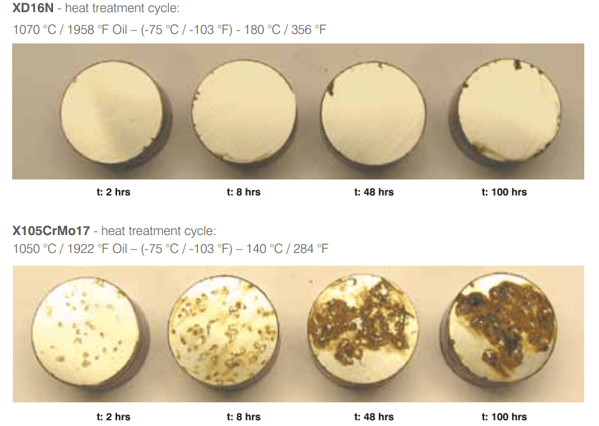
XD16N (top) and 440C (bottom) in a salt spray corrosion test, courtesy of Aubert & Duval
When comparing XD16N to PH grades and 300 series stainless steel, the corrosion performance is comparable (admittedly “almost” as good as these grades, and significantly better than 440C). What you gain with XD16N is the high hardness and fine carbide microstructure that prevents wear or fatigue, which extends the life of your part.
XD16N is unique as a CREN steel because it is an air-melt steel. Eliminating the need for vacuum melting keeps the cost reasonable while still delivering CREN‑level performance. As a bonus, the simplified production also, generally, means shorter lead times and greater availability.
XD16N forms a fine, uniform grain structure that can be conventionally heat treated to a hardness of 58 HRC. This is slightly less than 440C’s hardness (~58-61 HRC). But, when you take a closer look, XD16N doesn’t have any of the large, brittle carbides common in 440C that encourage crack propagation and reduce toughness.
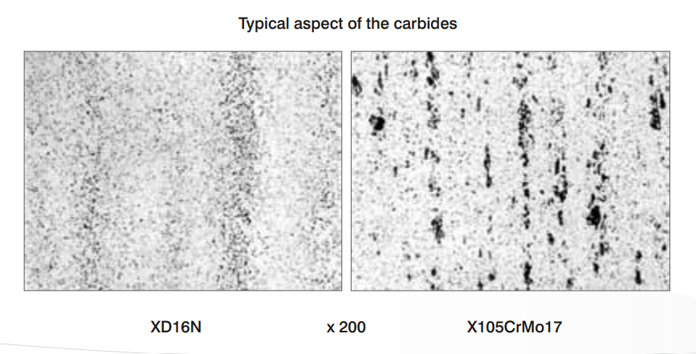
Aspect of carbides, XD16N vs 440C, courtesy of Aubert & Duval
XD16N’s fine microstructure gives it superior toughness to 440C without sacrificing hardness. The tight microstructure also extends fatigue life, reducing the risk of sudden or premature failure in high‑cycle applications.
If you’re fighting the constant “wear‑out” cycle of PH grades, XD16N provides a clear upgrade. It achieves a 58 HRC while maintaining the excellent stainless reliability PH steels are known for (see the next section for how). The result is a material that resists both corrosion and wear—without forcing you to trade one for the other.
Note: XD16N is receptive to through hardening and induction surface hardening.
Chrome in a steel’s chemistry can result in excellent corrosion resistance, but only if it’s free chrome. For a stainless steel like 440C, the hardening process consumes free chrome during the heat-treat process to form chromium carbides. In short, 440C has a decent amount of chrome, but after hardening, only a small portion of it remains free to prevent corrosion.
| Grade | C | Mn | Si | P | S | Cr | Mo | V | N | Ni | Cu |
| 440C | 0.95-1.20 | 1.00 max | 1.00 max | 0.04 max | 0.03 max | 16.00-18.00 | 0.40-0.65 | -- | -- | 0.75 max | 0.50 max |
| XD16N | 0.45-0.60 | 0.80 max | 1.30-1.70 | 0.03 max | 0.02 max | 15.00-16.50 | 0.20-0.40 | 0.20-0.40 | 0.05-2.00 | 0.40 max | -- |
Chemistries as defined in each grade's respective AMS.
A CREN (Corrosion Resistant Nitrogen) steel like XD16N, on the other hand, maximizes free chrome. The “magic” is the nitrogen in its chemistry. Instead of relying on a matrix of chromium carbides for hardness, XD16N forms carbonitrides, leaving 100% of the chrome in the steel’s chemistry available for corrosion resistance. As such, XD16N resists rust and pitting in ways 440C never could.
Switching from 440C or a familiar PH grade can feel like a big step. But if your current material isn’t delivering the performance you need, it’s worth exploring options like XD16N.
At Sullivan Steel, we understand the challenges many industries face. Whether you’re downloading a datasheet, requesting a quote, or curious which grade will deliver the performance you need, we’re here to help.
Start a live chat or contact Sullivan Steel today.