
Short Lead Times
Expect fast responses, rapid turnarounds, and on-time delivery.
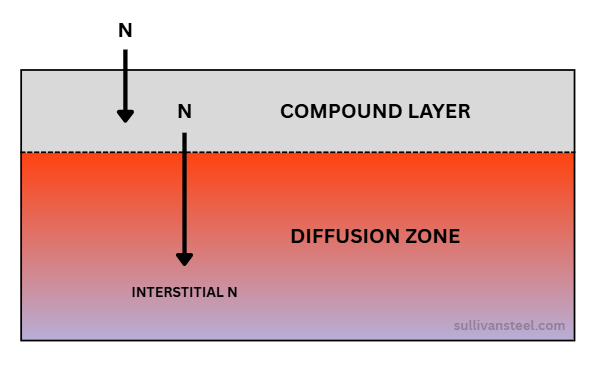
Nitriding is a niche case hardening process that diffuses nitrogen onto the surface of a steel component, forming a thin, ultra‑hard case while keeping the core ductile. The case consists of two zones: a brittle “white layer” at the surface and a diffusion layer beneath it that transitions toward the core material. As a more complex process than carburizing, nitriding is typically only selected for parts that demand a very hard, very thin case.
Nitriding is distinct in several ways. First off, it takes place below a steel’s tempering temperature, which is why a component usually undergoes through hardening (heat, quench, temper) prior to nitriding. Second, the lower temperature means less risk of dimensional distortion—an advantage over carburizing. And third, the number of nitriding-specific grades is relatively small.
Successful nitriding hinges on the tight control of the process, including nitrogen concentration, duration, temperature (and more).
See below and our products page for the nitriding grades Sullivan carries.
Nitriding forms two distinct layers on the surface of a component. The outermost is the white layer (or compound layer) made up of nitrides that form with the alloying elements in the steel. It’s extremely hard but also brittle. Beneath this lies the diffusion layer, where nitrogen decreases in concentration toward the core of the part.
As nitrogen bonds readily with elements like aluminum and chromium, nitriding steels often include these alloys to promote the harder case. The trade‑off is that higher alloy content slows the process, increasing both time and cost.
Nitriding also creates beneficial residual compressive stresses on the surface of a part, which can counteract external forces and improve a part’s durability and resistance to wear.
Before beginning to consider hardening options, it’s important to understand a component’s in‑service performance requirements. These guide decisions such as material choice, heat treatment, manufacturing methods, and more.
Should nitriding be the favored case hardening method, the process will be designed to achieve specific microstructures, controlling the depth and composition of both the white and diffusion layers, while avoiding the formation of grain boundary nitrides.
Several nitriding methods are in use today.
The first nitriding technique developed, gas nitriding remains the most widely used. The process takes place in a furnace and uses ammonia (NH₃), which thermally decomposes to release nitrogen. Controlling the rate of ammonia dissociation is key to a successful process.
Gas nitriding can be performed in one or two stages—the second stage, sometimes carried out at a higher temperature, adjusts the dissociation rate to deepen the case while thinning the white layer.
This method, called salt nitriding or liquid nitriding, uses molten salts to impart nitrogen onto the surface of a component. While effective, it’s less common than gas nitriding because the disposal of hazardous spent salts poses environmental and regulatory challenges.
The most advanced technique, ion plasma nitriding, is performed in a vacuum using specialized equipment. Parts are electrically charged, and when nitrogen gas is introduced, it ionizes into plasma that diffuses into a component’s surface layer. This method offers greater control than gas or salt nitriding, though fewer suppliers have the capability to perform it.
The white layer formed in nitriding offers excellent performance for hardness and wear resistance—ideal for parts like spools or sleeves that need high hardness, corrosion resistance, and pitting resistance.
However, because the white layer is brittle, it’s often removed to expose the tougher diffusion layer beneath, which is not as prone to cracking under rolling contact conditions.
Nitriding may be an option for parts too thin for carburizing. High-contact ratio gear teeth are a prime example: nitriding produces a thinner case than carburizing, hardening the surface while maintaining a softer core. If hardened all the way through, a gear tooth may be prone to through-section fracture and potentially break off in service.
Unlike carburizing, standard gas nitriding doesn’t add carbon, allowing a hard case to form without compromising the steel’s corrosion resistance—a key advantage for applications in corrosive environments.
Deciding if a part requires nitriding depends on factors like a component’s stress profile, manufacturing process, vendor availability, and cost. But when conventional case hardening methods can’t deliver the required performance or properties, nitriding may be the solution.
Sullivan Steel stocks nitriding grades, including:
If you have questions, don’t hesitate to reach out to us. Whatever your challenges, we’ll work through them together.
Start a live chat or contact Sullivan today!
https://gearsolutions.com/departments/hot-seat/nitriding-of-steels/
https://www.nitrex.com/en/nitriding-strengthening-stainless-steel-against-wear-fatigue-beyond/
https://vacaero.com/information-resources/metallography-with-george-vander-voort/1138-microstructure-of-nitrided-steels.html
https://fractory.com/nitriding-explained/
https://www.totalmateria.com/en-us/articles/nitriding/
ASM handbook Volume 4A Steel Heat Treating Fundamentals and Processes